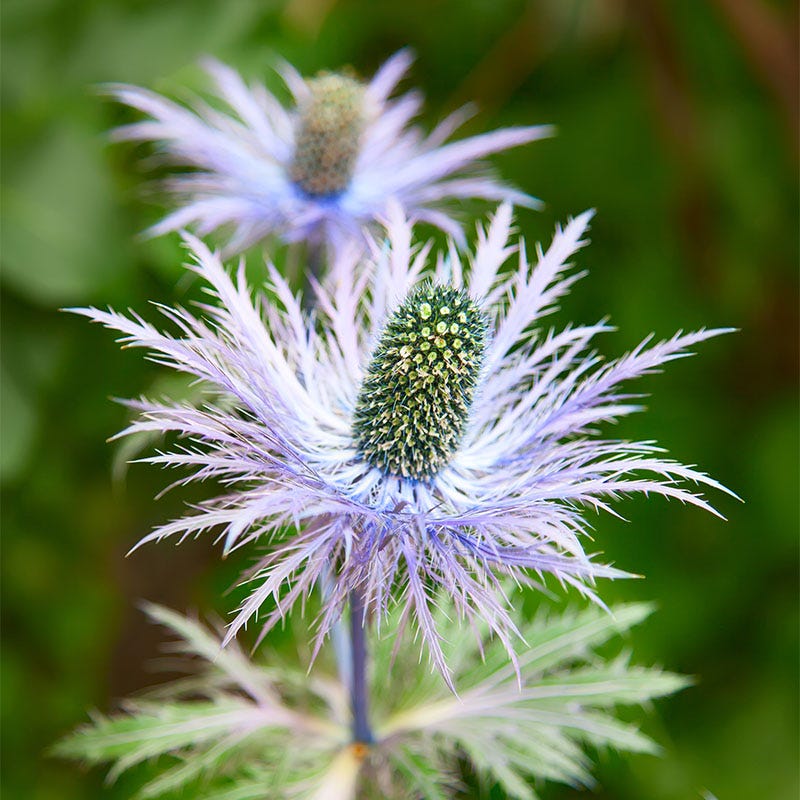
Blue Star Sea Holly
Here's a fascinating plant, new to us this year. But hardly new. Most Sea Hollies grow along the Mediterranean coast as striking blue wildflowers, and they have been admired for centures. Even Plutarch wrote about this plant in ancient Rome! One of the species also grows in the Alps, and that one is Erynigium alpinum, or Alpine Sea Holly. Our selection is from that species, and said to be one of the bluest of them all.
The great British gardener of the Edwardian period, William Robinson, the first plant expert who was seriously interested in wildflowers, said Sea Holly was his all-time favorite. Stunned by the blue coloring, rare in flowers, he wrote that Sea Holly was not surpassed in beauty by any plant! Quite an endorsement.For good growth, Sea Holly requires full sun and a gritty, fast-draining soil, so site yours carefully. The flowers arise in mid-summer from plants about 30 tall, and by the way, both the leaves and roots are edible.
Here's a fascinating plant, new to us this year. But hardly new. Most Sea Hollies grow along the Mediterranean coast as striking blue wildflowers, and they have been admired for centures. Even Plutarch wrote about this plant in ancient Rome! One of the species also grows in the Alps, and that one is Erynigium alpinum, or Alpine Sea Holly. Our selection is from that species, and said to be one of the bluest of them all.
The great British gardener of the Edwardian period, William Robinson, the first plant expert who was seriously interested in wildflowers, said Sea Holly was his all-time favorite. Stunned by the blue coloring, rare in flowers, he wrote that Sea Holly was not surpassed in beauty by any plant! Quite an endorsement.For good growth, Sea Holly requires full sun and a gritty, fast-draining soil, so site yours carefully. The flowers arise in mid-summer from plants about 30 tall, and by the way, both the leaves and roots are edible.
Description
Here's a fascinating plant, new to us this year. But hardly new. Most Sea Hollies grow along the Mediterranean coast as striking blue wildflowers, and they have been admired for centures. Even Plutarch wrote about this plant in ancient Rome! One of the species also grows in the Alps, and that one is Erynigium alpinum, or Alpine Sea Holly. Our selection is from that species, and said to be one of the bluest of them all.
The great British gardener of the Edwardian period, William Robinson, the first plant expert who was seriously interested in wildflowers, said Sea Holly was his all-time favorite. Stunned by the blue coloring, rare in flowers, he wrote that Sea Holly was not surpassed in beauty by any plant! Quite an endorsement.For good growth, Sea Holly requires full sun and a gritty, fast-draining soil, so site yours carefully. The flowers arise in mid-summer from plants about 30 tall, and by the way, both the leaves and roots are edible.