Turk's Cap Lily Seeds
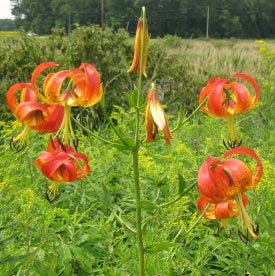
Turk's Cap lilies are the ones that some long-ago botanist thought looked like turbans, the headgear of the Turks. It means the blooms face downward like large bells, and each petal tip curves back as on a "turk's cap." Native from New England all the way to Florida, and west to Illinois, the American Turk's Cap is not common, so if you can cultivate it in your wild garden, it will be special. (the bulbs were cooked for soups by the early Indians.)
Remember, you are planting seeds, and they will take a year or more to make a bulb, and then the tall stem, buds and blooms can form, so be patient with your "Turk's Cap Lily."
Turk's Cap lilies are the ones that some long-ago botanist thought looked like turbans, the headgear of the Turks. It means the blooms face downward like large bells, and each petal tip curves back as on a "turk's cap." Native from New England all the way to Florida, and west to Illinois, the American Turk's Cap is not common, so if you can cultivate it in your wild garden, it will be special. (the bulbs were cooked for soups by the early Indians.)
Remember, you are planting seeds, and they will take a year or more to make a bulb, and then the tall stem, buds and blooms can form, so be patient with your "Turk's Cap Lily."
Description
Turk's Cap lilies are the ones that some long-ago botanist thought looked like turbans, the headgear of the Turks. It means the blooms face downward like large bells, and each petal tip curves back as on a "turk's cap." Native from New England all the way to Florida, and west to Illinois, the American Turk's Cap is not common, so if you can cultivate it in your wild garden, it will be special. (the bulbs were cooked for soups by the early Indians.)
Remember, you are planting seeds, and they will take a year or more to make a bulb, and then the tall stem, buds and blooms can form, so be patient with your "Turk's Cap Lily."